Showing posts with label Oregon. Show all posts

Thursday, February 4, 2016

A Whale of a Beach Find

One of the very best things about my career as a marine biologist is that I never know what to expect.  Sure, I spend about 40 or 50 hours a week staring at a computer screen, but there are times when I walk into the office one morning and get invited to do things like help teach a field course on marine biology, help disentangle whales, or even visit a beach where a Japanese boat has washed up.  But what happened in November 2015 is a memory that will stay with me forever.

Sometimes in science you get so busy and engrained in your work that you are loathe to take any time off- including weekends and evenings.  This can happen for months at a time.  But when somebody tells you that the first blue whale ever has washed up on an Oregon beach 3 hours south, there isn't much you can do besides get up at 4 in the morning and drive there at your first chance- which is exactly what I did!

Sometime in the hours between November 2nd and 3rd, 2015, an adult blue whale- the largest animal to ever have lived on planet earth- washed up on Ophir Beach, Oregon.  Ophir Beach is a secluded beach between Gold Beach and Port Orford.  The whale was a 75-foot long male; meaning it was a small mature adult and weighed somewhere between 60 and 75 tons - meaning 120,000 pounds, or more than the size of 10 of the biggest elephants.  News reports, of course, put the whale at 100 tons, which is an overestimate for this animal.

Two things told me I had arrived at Ophir Beach- an unusual number of cars parked in a pullout in the  middle of nowhere on Highway 101- and the smell.  Before I could even see the whale, I could smell it; it was a mixture of what I always thought of as a 'concentrated ocean' smell and the unmistakable odor of decaying marine mammal.  Upon getting out of the car and heading down to the beach, the wonder of the moment caught up to me.  Down by the tide line, laying on its side was the most beautiful, incredible and tragic animal I had ever seen.  My feeling of elation as a biologist was mixed with sadness for the animal and its fate. I have never been both so solemn and in wonder of nature at the same time.

My first look at the whale.  Oregon Marine Mammal Stranding Network Coordinator, Jim Rice is there to greet me!
(Work done under NMFS/MMPA and Oregon State University Permits)
Upon getting set up and donning protective gear (gloves, waterproof bibs, boots, hat) I set up for my first task, which was to remove the baleen so that it could be used for a research project studying the dynamics of feeding in baleen whales.  It was a race against the tide, so I spent the day in the mouth, sitting on the tongue of the world's biggest animal.


Removing the baleen involved a strong stomach, lots of muscle, and hand tools in a rush against the tide.
(Work done under NMFS/MMPA and Oregon State University Permits)

When whales wash up on beaches, one of two problems often arise: 1) these large animals attract large numbers of people, presenting health and safety hazards for attracted beach goers.  The two days I was there, and surely for the rest of the week, people were running across the highway to access the beach.  Additionally, many marine mammals (especially decomposing ones) can carry diseases that are easily transmitted to humans or pets such as dogs.  The second problem is that, while the animal is certainly neat for a day or two, sooner or later the stench of decay and the prospect of removing such a large rotting animal becomes worse by the day, often causing complaints.  Therefore, stranding networks are often presented with the options of removing the animal from the beach or burying it.  In the case of Big Blue (my name for him), the opportunity to salvage the skeleton as a display for generations to come was too good to pass up.  There are few places that have  articulated blue whale skeletons, but they are an amazing sight.  Therefore, a team of hardy, resilient and optimistic volunteers worked all day long for over a week- mostly with hand tools- to strip down the carcass before the ocean (or beachcombers) could break it down.

After removing as much of the baleen as we could the first day (we worked right up until the tide moved back over the whale), I and others began 'flensing' the blubber off the whale- removing it in strips- so that we could get at the muscle tissue, perform a necropsy to discover how the animal died, and finally get to the bone.  Flensing is hard, endless work that would have been much harder had we not had a designated knife sharpener!  As brutal as the commercial whaling industry was (and still is), I gained some respect for the men that would do this job for often hundreds of days at sea; instead of working on a whale on the beach over several days, they would have but a few hours to climb on the whale hoisted to the side of a moving boat, and somehow remove the blubber without falling into the water.  Comparatively, we had it easy.

"Whalers' Bay" by Carl Dørnberger shows whalers flensing a whale off the side of a boat (1920). They did not have the benefit of vinyl rain gear or peanut butter sandwiches during breaks.


Not much has changed in terms of method in the last 95 years...however, we now use stranded whales for public education and conservation rather than harvesting them.
(Work done under NMFS/MMPA and Oregon State University Permits)


I grudgingly had to return after two days of helping because I had my upcoming qualifying exams for my doctorate in two short weeks.  However, there are lots of folks from many different institutions, including students from Oregon State University, Oregon's Marine Mammal Stranding Network, and Humboldt State that worked tirelessly to make this happen.  Along the way we answered the questions of curious beach goers and somehow completed the whole effort without a major injury (I very nearly took a mallet to the face).  (And the smell did not improve over time.  The deeper we got and the more we removed, the more rotten it became.  Within a couple of days after it was removed, it would have been a rotten blob of tissue on the beach, lost to the tide and scavengers (there was a bear sighted nearby while we were working).


This photo was taken at the end of the first day.  Notice the oil coating my overalls.  This permeating oil -originally what whales were harvested for- is something that never, ever washes out and the smell remains.
(Work done under NMFS/MMPA and Oregon State University Permits)

All in all, what would be unthinkably smelly or gross work for some was an amazing biological opportunity and a lifetime experience for me and many others.  I wonder what that whale saw during his lifetime, how his last days came to play, and how old he was.  I'll never forget that first moment when I walked on that beach, or what if felt like to stand, dwarfed, under his towering tail fluke. Some of these questions will be answered- for example, he was an extremely thin animal- and others are left up to the imagination.  The best outcome of the whole event is that by preserving his skeleton, people for generations to come will be asking the same questions.

Standing by the tail of this beautiful behemoth. This 75-foot whale was approximately 3/4 the size of the biggest adults, which can reach 100-feet in length.
(Work done under NMFS/MMPA and Oregon State University Permits)

All of the workers on this project were working purely out of a volunteer basis- we all showed up out of the sheer excitement of the opportunity and experience.  In fact, the Oregon Marine Mammal Stranding Network nearly lost its funding a year ago due to government cuts. Without our stranding coordinator and volunteers, nobody in Oregon would be able to respond to calls like this of stranded animals. If you'd like to learn more about the OMMSN or the Marine Mammal Institute, you can visit the webpage at: mmi.oregostate.edu.

Exhausted, oily, but enthusiastic.
(Work done under NMFS/MMPA and Oregon State University Permits)

Tuesday, May 27, 2014

Boats continue to roll in, as spring winds dissipate

As spring's easterly winds die down (at least for now), what is likely the last of the wave of boats to reach US shores is rolling in.

Despite a Memorial Day Weekend with relatively calm weather, 3 boats were found on Washington beaches, as well as one boat in Oregon (by me!). Another boat has been reported south of Waldport, Oregon but has yet to be located.

The first of the three Washington boats was found near Ocean Park on May 23, and was approximately 20 feet long. It included mainly Lepas antifera, pelagic gooseneck barnacles.


Next, 2 more boats were sighted on May 24 in the Long Beach Washington area near Seaview Beach and Bolstad Beaches by Washington State Parks Recreation Commission Long Beach Area manager Tom Benenati. Benenati helped with sampling the boat and coordinated the removal of them from the beach, where they will await identification and communication from the Japanese Consulate.


The three vessels that washed ashore in Washington State this Memorial Day weekend. Photo: Thomas Benenati, WSPRC

Lastly, my discovery on May 26 (Monday) is evidence that you never know what you are going to find on the beach! I had journeyed down the South Trail at Cape Lookout with my boyfriend and spotted the partial bow of a boat about 1/2 a mile up the beach. Evidence that preparedness is everything, I of course had no proper camera or bags for collecting samples of any sort. Working against the impending rain storm, we removed a few of the ~20 mussels from the boat and snapped some photos with my iPhone. I am sorry to say that I of all people was not more prepared for this one! The boat was only a partial deck (the bow end) with a rectangular hold containing a few clumps of mussels, bristly hydroids, and the remains of some very sad-looking gooseneck barnacles- the boat had likely been sitting for a duration of several days.

The boat section as I found it on Memorial Day. Partial covering in sand and lack of marine life suggests it had been there for a while. (Photo: Sheanna Steingass)

This brings our boat total since April 23, 2014 up to 25 vessels! This number is a reminder that we should really appreciate all of the parks employees, ODFW/WDFW employees, scientists, non-profits, and volunteers for the tremendous amount of work that they have put in the last 2 years.  Many folks have devoted a lot of their time quickly responding to, cleaning up, and studying the tsunami debris that has reached our shores.  Keep up the good, and very important work that is keeping our beaches clean and safe!

The moral of the story is, it never hurts to bring the basic beachcombing essentials with you on the beach- gloves, bags, and a camera.
 

Thursday, May 22, 2014

Two more boats, dock section wash ashore in Oregon


Adding to the enormous amount of marine debris that has washed ashore on eastern Pacific shores this week, two more boats (one intact, the other partial) and a small section of floating dock have washed ashore in Oregon today.

The first boat, although somewhat dilapidated, contained some biological surprises-  three live sea stars, an anemone, mussels and the giant red barnacle which has made many appearances- Balanus rosa. 

The boat found at Carter Lake that contained 3 live sea stars. (Photo: Scott Groth, ODFW)
The sea stars have been confirmed to be of the species Patiria pectinifera, a Japanese species- meaning they have made the journey intact across the Pacific Ocean.  Sea stars are predators, so they likely survived by eating barnacles and bivalves attached to the boat as it floated.  The concern is that invasive species could continue to do this and establish themselves in the rocky intertidal zones of the United States and Canada- potentially displacing important keystone predators such as purple and sunflower sea stars.


Some very cool, but potentially invasive sea stars were found hitchhiking aboard the vessel.  (Photo: Scott Groth, ODFW)

The second boat came ashore near Tahkenitch Lake and was in excellent condition.  It was approximately 22 feet in length, and had an intact hull ID plate, which will help to trace the vessel back to its original port and owner.  The boat was much less biologically diverse, and contained mostly pelagic gooseneck barnacles.

Boat ID plate that may help trace the boat back to it's origins (Photo: Scott Groth, ODFW)
The intact vessel that washed ashore.  (Photo: Scott Groth, ODFW)

Lastly, near the outlet of the Suislaw River (adding to the pattern that marine debris tends to wash up near fresh water outlets), a small section of dock as well as a net washed up.  The dock section was approximately 6' x 4' x 4' and had two live limpets on it.  Limpets have been an unusual occurrence on Japanese tsunami marine debris thus far, but have made a couple appearances in this recent pulse of items from Japan.


The section of concrete dock that washed ashore near the Siuslaw River (Photo: Scott Groth, ODFW)

A graph showing the increase in boats found since 2012.  That number has more the doubled in the last month- this number is only representative of reported boats; there are likely many more. (Sheanna Steingass)


 Reports of more major and culturally-significant debris are likely to pour in these coming weeks- come back soon!

A special thanks to Scott Groth (ODFW) for the excellent sample collection and photography of the latest debris.


Tuesday, May 20, 2014

TEN Boats Wash Ashore on Pacific Coast in 3 Weeks

 Update: ANOTHER boat washed ashore at Cape Arago yesterday (May 20th), making the new number of boats nine TEN.  More on this boat soon.

Boat #10 makes it ashore in Cape Arago, Oregon


In what has been an absolutely peak week and month in tsunami debris,  thousands (perhaps more) of pounds of marine debris from the tsunamis, as well as normal debris, has washed ashore on the shores of the eastern Pacific ocean.

Strong winds blowing eastward in the California Current System (Washington to Baja) has driven marine debris straight inshore and onto beaches.  Perhaps most surprisingly, this has included nine Japanese skiffs that have been cataloged as likely tsunami debris on US beaches.  This includes two boats in Washington, one in California, and six in Oregon state alone.  Along with these nine boats are likely others that have washed ashore on remote beaches, or have not been reported to authorities.  All boats have had live Japanese mussels (Mytilus galloprovincialis), a potential invasive species, as well as hydroids, byrozoans, worms sponges, and even anemones according to Dr. Jim Carlton of Williams-Mystic Maritime Program. Further details on the boats, as well as a map with photos and links to news articles can be found at the bottom of this post.

In addition to these boats, large amounts of floating debris have landed on beaches, prompting state and region-wide beach cleanups.  One five mile stretch of beach, for example, yielded more than 120 bouys of various sizes- many of which were Japanese or Asian in origin.
One of many bouys washed ashore this month.

I had a chance to go visit this beach after the cleanup of more than 70 objects, and found at least 50 more still in less accessible areas.  My estimate is also very conservative.  I was able to photograph many of these objects, but had to turn back due to time constraints.


Objects of all sizes littered the beach.

On May 15 and 16, two boats washed ashore in Oregon- a skiff north of the Umpqua River, and a 25-foot skiff in Brian Booth State Park near Newport.  This skiff was also accompanied by a large gill net of unknown origin.  I was lucky enough to go along and help Dr. John Chapman (Oregon State University) sample this boat before the Parks Department hauled it off before spectators could accumulate.

Axes or shovels are used to remove clinging barnacles and other organisms from marine debris for sampling.  I am never one to turn down an ax-wielding photo op!


The boat was teeming with pelagic gooseneck barnacles (Lepas anatifera) as well as approximately 50 non-native mussels, scallops, and drifter crabs. In the boat was a styrofoam cooler with intact Japanese text that had likely been trapped under the vessel for two years. After the boat was biologically sampled, state employees hauled it off the beach.


What else has washed up?  Hard hats, plastic debris, ropes, floats, styrofoam, shoes, toys, wood and construction debris, and many other floating objects.  Another interesting bit of debris is a bouy with Japanese limpets- to my knowledge this is an uncommon occurrence.  Both limpets were alive; the first (shown in the middle of the image below) is Cellana radiata, and the second is as yet confirmed but is likely a Lottia spp.

A bouy with oyster and live non-native limpets found inside Coos Bay.  Photo: Leif K. Rasmuson (OIMB)

If you find debris on the beach, please report it using the reporting form and remove it from the beach if it is non-hazardous.  Remember, do not touch any oil-coated or dangerous objects.  Please report any culturally-significant objects (boats, vehicles, religious or personal artifacts), or objects with a lot of marine life.  Check my debris resources page for your local authorities.

This month has been a reminder that, although the Tohoku earthquake and tsunamis happened over two years ago, we will be seeing marine debris washing ashore for a long time, with unknown ecological impacts.  If you would like to get involved and help with beach cleanups or other volunteer work, you can contact SOLVe or the Surfrider Foundation.


(A big thanks to Jim Carlton of Williams-Mystic Maritime Studies Program for compiling a great list of latest debris, and John Chapman of Oregon State University for keeping me up to date on all the debris!)

Monday, April 28, 2014

When starfish melt: Sea Star Wasting Syndrome

Sea Star Wasting Syndrome is the new buzzword in marine biology these days.  But what is it?  Sadly, nobody really knows for sure.  However, the consequences for large populations of sea stars on the Pacific coast are dire.

This problem was first noted in 1983-1984 and 1997-8 in Southern California during periods of warm water- particularly during El Nino. Groups of starfish on California beaches and below the tidal zone began to essentially fall apart, and in many cases die. These incidences lasted from Spring until fall, and were attributed to warm water and perhaps some type of disease.

This past year, however, starfish along California, Oregon and Washington began exhibiting the same characteristic symptoms of wasting syndrome, and these effects even lasted through winter months, which has historically not been seen.

Scientists at various institutions, including Melissa Miner of UC Santa Cruz, are trying to puzzle out what exactly is happening to these keystone marine predators. Melissa came and spoke at Hatfield Marine Science Center this month, and highlighted some of the major data gaps regarding the disease.

Here is what we do know about the syndrome:
1: Sea stars display a series of symptoms which can be identified as wasting disease.  These include the formation of white lesions on the body, followed by general decay, and eventual death in many cases. Stars may lose multiple arms if they do survive.

A purple sea star found in Newport, OR likely affected by the disease. Photo: Sheanna Steingass

2: There appears to be a two-step process in sea star wasting syndrome.  First, it is assumed that specific environmental 'triggers' start off the disease- unusual circumstances that cause stress to the animal.  These might include toxins, pollutants, temperatures, pH or any number of other unknown factors.  Then, a secondary infection likely affects the animal opportunistically.

3: The infection or pathogens appear to be spread by direct contact between individuals- bad news for species that often clump together.

4: There are more than just one species of starfish affected by the syndrome.  Sunflower stars (Pycnopodia spp) appear to be most heavily affected.  Other species include:

Pisaster species (Purple sea stars)
Evasterias species (Mottled sea stars)
Patiria mineata (Bat star)


Leptasterias species (6-armed sea stars)
Dermasterias species (leather stars)
Orthosterias koehleri (Rainbow stars)

Solaster dawsoni (Sun stars)
Pisaster giganteus (Giant stars)
Pteraster (Slime stars)

This is quite the assemblage of species!  Many of these animals play very important roles as predators in the intertidal ecosystem.  Interestingly, both individuals at or above the high tide line, as well as those below the tidal zone.  In fact, animals below the tidal line seem to be affected before those higher up. 

So what is being done about the disease?  
Scientists are doing their best to unravel this mystery.  Sea stars have been tested for radiation, and no abnormal levels have been found.  Therefore, it is unlikely that radiation from Fukishima has much to do with the syndrome.  

Tissue samples of affected animals are being sent to toxicology and pathology labs to test for infectious disease or toxins that may cause the disease.  So far, no consistent pattern has been found. (Yes, this is very frustrating!)

Where is this disease being found?
Sea Star Wasting Syndrome has been found in 59 of 99 (60%) of study sites along California, Oregon, Washington, and BC.  These include Vancouver BC,  Seattle, Monterey Bay and Santa Barbara.

How can I help scientists study wasting syndrome?
There is now a website where you can report sea stars that appear to be affected by the disease, as well as learn more about wasting syndrome.  Please visit http://www.eeb.ucsc.edu/pacificrockyintertidal/data-products/sea-star-wasting/  to learn much more and report your sightings!


Let's help out our intertidal friends.

Sea star aggregations such as this might increase spread of disease.

Monday, March 3, 2014

Winter storms push debris ashore in Pacific Northwest

A series of winter storms hailing strong western and southern winds has pushed tsunami debris ashore in the Pacific Northwest.

The debris ranges from larger to small objects, and is mingled with other nearshore debris along Oregon and Washington's beaches.

One such item, a section of a Yamaha boat, is believed to be tsunami debris and was found by a local resident on a beach north of Yachats, Oregon. 


Like other tsunami debris, it was covered in a variety of invertebrate organisms. It included several individuals of Mytilus galloprovincialis, or Mediterranean mussels (despite its name, it can be found in Washington, the Puget Sound, and also in Japan and other areas in Asia), gooseneck barnacles, and sea anemones.


Mediterranean mussels adhere to the section of Yamaha boat (Photo: John Chapman)


The section was approximately 13.5 by 21 inches and included a length of rope wrapped around a rail on the outer section.

There is no confirmation that this particular item is tsunami debris, however it is currently being evaluated.


The full section is shown here, measuring approximately 21" in length (Photo: John Chapman)

As winter storms continue into March, it is possible that more large pieces of debris could wash ashore during storms.  If you happen to find a piece of debris, please refer to my resources section for options to report the debris. Any live organisms should be reported to Hatfield Marine Science Center's Invasive Species Laboratory, via the reporting form.

Tuesday, October 22, 2013

It Came from Across the Pacific!


Just in time for Halloween, something scary has washed across the Pacific ocean, landing on the shores of Seaside, Oregon.  The object is approximately 6 x 3 x 2 feet, with a cement exterior.  However, it isn't the object itself that is scary; it is the creatures on it!

A 'mini' floating dock washed up in Seaside, Oregon on the morning of October 8th. The float was host to a plethora of live (and dead) organisms including limpets, chitons, mussels and the Japanese oyster Crassostrea gigas.  These animals are non-native to Oregon and definitively originate from Japan.  Evidence of layering noted by Dr. John Chapman of Oregon State University suggests multiple generations of organisms have survived the journey across the Pacific.

A small dock float washed up in Seaside, Oregon [Photo: Seaside Aquarium]

The dock was reported to the Seaside Aquarium, and sampled by members of ODFW.  The samples were sent to Dr. Chapman, and relayed to other experts in invertebrate identification.
Mussels, barnacles and limpets abound. [Photo: Seaside Aquarium]

Dr. James Carlton, of Williams College (MA) and the Williams-Mystic Maritime Studies  Program (Mystic, CT) has identified several of the organisms, including:

Live members of the mussel species Septifer virgatus, which he notes as an indicator species for Honshu debris:
Photo: Marinbio.org

Lithophaga curta, another Honshu species:

Photo: nmr.pics.nl


and Crepidula onyx, an introduced slipper limpet species in Japan- ironically enough, historically originating from California!
Gastropods.com
The species of chitons and limpets are yet identified, but I will be sure to post information as soon as it is available! The importance of the live organisms washing up on debris will likely not be fully apparent for years, but the animals could have significant impacts as invasive species on North American shores- a scary consequence that could cost billions of dollars due to ecological impacts.


Thanks to Drs. John Chapman and James Carlton for their valuable input and information!

Friday, October 18, 2013

Oregon Coast Aquarium among top 10 in US

I am proud to report that our local Oregon Coast Aquarium (Newport, OR) is among the top ten in the United States, as recently listed by FamousWonders.com.

They were noted for previously being the home of Keiko the orca, but also for their series of underwater Passages of the Deep, where guests tour a series of different Pacific marine environments, as well as their aviary and newly-remodeled marine mammal exhibit, which has a number of (very cute) harbor seals, California sea lions, and sea otters.  

Max the Sea Lion


Stop by if you haven't already!


Friday, June 14, 2013

Hardhat washes ashore in Southern Oregon

This just in from Coos Bay-

During the 2011 tsunami, immeasurable damage was reported.  More than 15,883 people lost their lives, with an additional 2,671 missing.  Additionally, almost 130,000 buildings completely collapsed, 254,204 buildings partially collapsed, and another 691,766 buildings- including homes, businesses, and community centers- were damaged.  To put this in perspective,  the total- 1,076,000 buildings- is more than the total number of buildings in the entirety of New York City... including Manhattan, the Bronx, Brooklyn, Queens, and Staten Island.

New York City- its nearly 1,000,000 buildings would be gone or damaged in the same scale of disaster.

On Thursday, June 13th, yet another unassuming, but strangely sobering object washed ashore near Tenmile Creek Coos Bay, Oregon. The object, stark in its simpleness and otherwise unassuming, is covered with peeling paint, evidence of being worn by somebody prior to the tsunamis.  It is a white hardhat, intact, its place of origin confirmed by the Japanese writing on the brim.

Peeling paint shows evidence of use. [Photo: Jeremiah Psiropoulos]

The hard hat is interesting in that, like the slipper that just washed ashore in Seaside, it represents a personal item that is a relic of life prior to the natural disaster.  It will likely never be known whether this item was being worn at time of the disaster, or was a personal or work effect of a survivor or victim.  Nevertheless, this durable piece of clothing reminds us of the purely human impacts of the disaster, and can be seen as a hopeful symbol of rebuilding communities, homes, and lives.

Japanese writing confirms its country of origin [Photo: Jeremiah Psiropoulos]


Wednesday, June 12, 2013

Slipper Washes Ashore in Oregon- Complete with Sealife

This in last week- another sombering reminder of the human impacts of the 2011 tsunamis washes ashore in Oregon.  In Seaside, Oregon a slipper has washed ashore covered in sealife like pelagic barnacles and bryozoans and/or hydrozoa (the original article says hydrozoans, but I'm not entirely sure this is correct), typical of debris that has washed ashore so far.

The slipper was brought into the Seaside Aquarium, where it was examined by staff.  The slipper is just one of many personal items that have recently washed up, including clothing, toys, children's shoes, and plastic containers. The shoe had Japanese writing on the sole,  confirming its origin.

The house slipper washed ashore [Photo: Seaside Aquarium]

Back in 2012, it was speculated that human feet may begin to wash up with debris, as shoes may maintain the integrity of the limbs, representing a grizzly occurrence that has happened in the past with fresh or marine water deaths.  Fortunately, this circumstance has not happened, and is not likely to, as most debris immediately sank following the tsunami. The chances of such a thing actually happening and then drifting across the ocean are very slim.

Wednesday, April 10, 2013

Relics Wash Ashore as Bulk of Debris Approaches US West Coast

Another Sacred Object Washes Ashore in Oregon

After a 16-foot beam of a Japanese Shinto Shrine washed ashore in Oceanside in March, a very similar 14 foot object has now washed ashore in Florence.  The wooden beam or kasagi appears to be the top part of another Shinto shrine- of which Japan has approximately 80,000- represents a spiritual relic for the Japanese culture.  Even though not all Japanese citizens practice the Shinto religion, Shinto shrines are culturally unique structures that are found in many important natural areas across the country.

The kasagi beam washed ashore near the Siuslaw River this week. The Japanese Consular Office in Portland has been contacted, but the situation will likely be deferred to Jinja Honcho, the Japanese Association of Shinto Shrines.

The 14-food red and black beam as found on a Florence, OR beach. [Photo: beachconnection.net]


Boat Covered in Barnacles Washes Ashore in Crescent City, CA

A 21-foot boat has washed ashore in Crescent City, California, making it one of the first larger objects to wash ashore south of Oregon.  The boat is covered in thousands of pelagic gooseneck barnacles (Lepas anatifera), a common oceanic colonizer, giving it a very odd appearance.

http://i.livescience.com/images/i/000/038/846/original/tsunami_boat.jpg?1365542867
Boat covered in pelagic gooseneck barnacles [Photo: Humboldt State University]
Once some of the barnacles were removed, the Japanese lettering for "Takada High School" was apparent- the high school was in Rikuzentakata City, which was heavily hit by the tsunami. The boat is currently being verified as tsunami debris, but it likely originated from the natural disaster. I will post more information as it is available.

Lettering on the boat, which tied it to a high school affected by the 2011 disaster [Photo: livescience.com]


NOAA Updates Marine Debris GNOME Graphic


Finally, NOAA has updated the GNOME tsanami debris model for the first time since early March.  As larger objects wash ashore on the west coast of North America, the projected critical mass of the debris moves towards US shores.  Click on the map for a larger version on NOAA's webpage.

http://marinedebris.noaa.gov/info/images/gnome_graphic.jpg

Monday, April 8, 2013

"Tsunami Fish" Makes His Debut

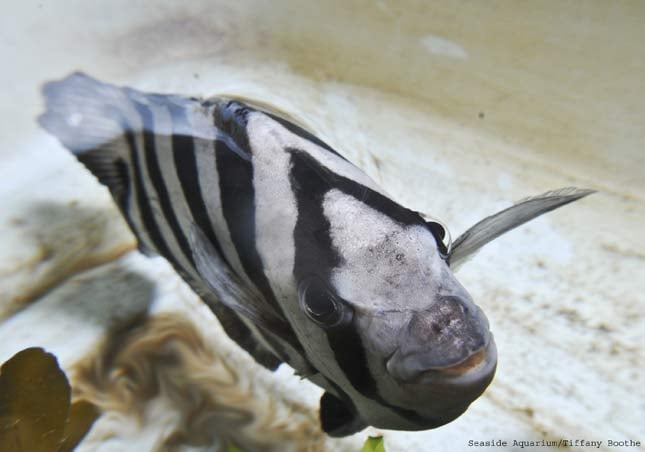
My favorite new celebrity, now dubbed "Tsunami Fish" (Couldn't they come up with a better name?  Tsu? Nami? Flotsam?)  is officially on display at the Seaside Aquarium.

The small rock bream, or striped beakfish that recently made its way from Asia to Oregon amid a piece of tsunami debris has been place on exhibit at the Seaside Aquarium. He is the only surviving member of the group of five live fish that made the journey across the Pacific.


If you'd like to go see him or learn more about the aquarium, visit SeasideAquarium.com.

Thursday, February 21, 2013

Two Boats: More Possible Debris?

This just in, bloggers!

Boat washes ashore in Southern Oregon
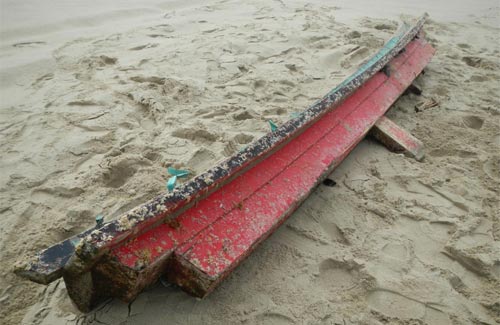
Another piece of large debris has washed up near Coos Bay, Oregon.  It is yet another boat, with writing on it that could pinpoint its port of origin.

It is yet to be determined whether this is tsunami debris or not- more soon!


Possible tsunami debris washes up on Oregon Coast
Newly-washed up boat near Coos Bay, Oregon {Photo: BLM}

Thanks to my ever-diligent debris source for this.

Boat washed ashore in Hawaii confirmed as tsunami debris
A 28-foot boat that washed ashore in Oahu, Hawaii has been confirmed as tsunami debris.  The boat was spotted last week by a fisherman, who tried to tow the boat inshore but couldn't.  It washed up a few days later- early this week- on the Kahuku Golf Course.  It indeed had Japanese writing on it, and according to reports has been confirmed as JTMD (Japanese Tsunami Marine Debris)

28-foot boat washed ashore in Hawaii.  Better photo when one is available. [Khon2.com]