Showing posts with label nuclear. Show all posts

Thursday, April 4, 2013

Japan Copes with Debris and Devastation on its Own Shores

 Debris and Tsunami Damage Presents Logistical Problems for Japan

After the 2011 tsunami in Tohoku, Japan, anxious eyes have peered towards the shores on the other side of the Pacific- Alaska, Hawaii, British Columbia, and the US continental Pacific Coast.  However, for those who were caught in the epicenter of the disaster, this turning away is perhaps the worst thing.

More than two years after the events of March 2011, Japan is still struggling to establish a normalcy that has been severely disrupted by natural disaster.  Recently, the Miyagi prefecture- where a majority of the damage occurred (Along with Iwate and Fukishima) - established a 10 year recovery plan to cope with the millions of tons of debris from destroyed architecture and other objects. 

Iwate and Miyagi together still have over 600,000 tons of debris left to clean up.  However, due to recent decreased estimates in the amount of debris, many fear losing essential funding that is being allotted for such efforts. 

Emptied: These shots by Yoshiichi Yanai show panoramic views of Naraha, Fukushima Prefecture, on March 2 and on the day after the March 11, 2011, disasters.
Before (bottom) and after (top) photos of a location in Naraha, Fukushima Prefecture. [KYODO]


One town in particular- Ishinomaki, has an especially large amount of debris. The Jakarta Post reported the deputy chief of the reconstruction policy bureau stated the debris came from the remains of 53,742 damaged structures. He also stated that that volume of debris would take over one hundred years to accumulate as 'waste' at a natural rate.

Automated Cleanup Processes

Japan is relying on spectacular technology to help with cleanup of debris, which would be a nearly impossible manual task.  The process is as follows:

1: Debris is separated into 'rough' groupings- such as timber, building materials, appliances, etc. and trucked to corresponding waste  management facilities in a nearby establishment- more than 14 prefectures have offered services for disposal, despite initial concerns (since calmed) that the debris may be radioactive.

2: The debris is then loaded onto conveyer belts, where the debris is separated into combustible and non-combustible materials. Combustible materials are incinerated.

3: Non-combustible materials are further sorted an disposed of as necessary.

More than 1/3 of debris has been cleaned up, but some are still not satisfied with the level of progress thus far.  In addition, recovery efforts have been slowed as many have moved inland to seek further employment.  Those remaining are being employed to the best extent in the cleanup.

Businesses that were affected by the disaster are doing their best to recover.  An interesting case noted by the Jakarta Post was that of a fish cannery. The cannery's president, Nigato Kimura, was determined to save his product.  More than 400 of his cans  of fish product were buried, and Kimura and his workers spent months recovering the cans, which were then sold both to restaurants and those who wished to support his business. 

Kimura is a fortunate example of an impacted business- in general, victims of the 2011 disaster- including entire villages - completely lost their livelihoods, as well as all possessions.


Sources:  Tisnadibrata, Ismira Lutfia. "Japanese Giant Works to Process Tsunami Debris." Jakarta Post. March 19, 2013. <http://www.thejakartapost.com/news/2013/03/19/japanese-giant-works-process-tsunami-debris.html>

Johnston, Eric. "Plummeting Debris Estimates Belie Pleas for Disposal Aid". Japan Times Online. March 10, 2013. <http://www.japantimes.co.jp/news/2013/03/10/national/plummeting-debris-estimates-belie-pleas-for-disposal-aid/#.UVyX4VdQ-vg>


Radiation a Diminishing but Very Real Concern in Japan

The earthquake and tsunamis that occurred caused massive nuclear disaster at the Fukishima Daiichi Nuclear Facility, in Fukishima Japan.  As a result, nuclear radiation was leaked from the facility both purposefully (to prevent potentially hazardous gaseous buildup) and due to containment failures from physical damage and power failures.  Radioactive material continued to leak throughout 2011 and 2012.

Read more about the details of the disaster in my Nuclear Impacts Part I and II posts.

On the International Nuclear Event Scale (INES), Fukishima is the second event only - after Chernobyl - to be rated a 7 out of 7.

A spectacular image of the containment process at Fukishima, shortly after the disaster.  A full size photo can be found here.

On a biological scale, the radiation levels appear to be surprisingly low.  Higher levels of radioactive contamination have been  noted in nearby fish or birds, but farther away from the disaster zone, results are more modest.  However, part of the problem comes from the question of how to categorize 'safe' levels of radiation.  We are all bombarded by a background level of radiation on a daily basis, but it is when the ratio of radioactive particles relative to non-radioactive particles becomes to high that we are in danger. 

Interestingly, the general levels of radiation remaining around Fukishima are certainly higher than they used to be, but they are still lower than the background radiation levels in other parts of the world, such as Kerala, India- one of the locations with the highest background radiation levels in the world.

At the end of 2011, Fukishima was rated the #1 most radioactive location on Earth- this is certainly no longer the case.

There is much ahead for Japanese government as they perform risk assessments, cleanups, and decide what levels are truly environmentally safe. It will be a long time before permanent impacts, if any, are a consideration.  Outlooks appear to be optimistic, however they should not deter from the urgency of cleanup efforts that are currently taking place.
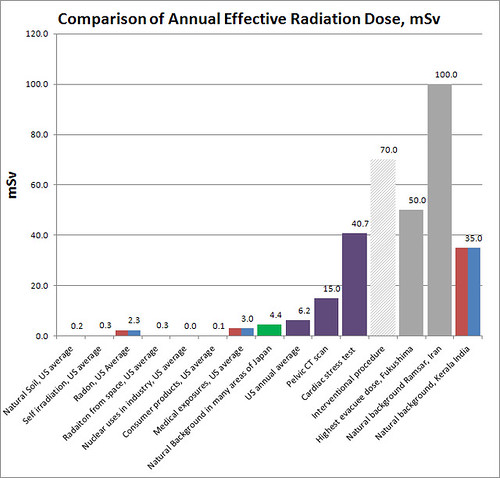
Radiation dose comparison
OSU's chart of radioactivity levels across the globe.  Note that Ramsar, Iran exceeds Fukishima's highest evacuee dose- the amount of radiation found in an individual who was evacuated from the area. 

Source: Oregon State University. "Fukishima Cleanup Continues, Many Areas Restored" February 2013. <http://oregonstate.edu/ua/ncs/archives/2013/mar/fukushima-cleanup-continues-many-areas-restored>


Wednesday, October 24, 2012

Radioactive Tuna?

Radiation: Human Impacts

As with any historic event, the Fukushima disaster created almost as much hype and disinformation as reliable information.  Unfamiliarity with the process of radiation created panicked speculation regarding US food supplies, ocean contamination, and visions of glowing radioactive tuna inhabiting the Pacific Ocean.

 It is true that tuna are at the top of the food chain, and therefore act as 'bioconcentrators' of many marine contaminants- that is, they have the tendency to assimilate biotoxins (radiation, toxic substances, plastic derivatives) into their body tissues at a rate greater than it is metabolized or excreted back into the environment. This is especially an issue for top predators, as a small level of contaminants in one individual prey multiplies over time as many prey are consumed. When this begins at the very bottom of the food chain, the effects are even more amplified.

Bioaccumulation of Polychlorinated bisphenyl- a plastic derivative- through the food chain (worldoceanreview.com)
The effects of bioaccumulation have been studied for several types of plastic derivative, as well as heavy metals (mercury), and naturally occuring toxins, such as Domoic Acid, which is found in shellfish.  The effects of radioactive bioaccumulation have also been studied as well, and in large amounts this could be an issue.  (For more information on radiation, see my previous entry).

In the months following the Fukishima event, scientists scrambled to decide whether or not this disaster would affect the world and US food supply.  While tuna have tested positive for small amounts of radiation, the levels are certainly not that which would have any biological impacts.  Scientists at Oregon State University have continued to test Pacific Albacore tuna for radiation, and have found that fish are radioactive far below any dangerous levels.

Delvan Neville, a grad student at OSU's Radiation Health Physics program, quoted for OSU's news website, "“To increase their normal annual dosage of radiation by just 1 percent, a person would have to eat more than 4,000 pounds of the highest (radiation) level albacore we've seen.”'

Consuming highly radioactive food could have immediate health impacts, as well as long-term issues such as cancer, reproductive problems, organ damage, or blindness.  However, the likelihood of mercury poisoning from consuming tuna is higher than experiencing any radioactive effects.  The FDA recommends an average adult of 140-180 pounds (female and male, respectively) to eat no more than 4.4-5.6 ounces of albacore, or 12.8-16.4 ounces of white tuna a WEEK.  This small amount of fish will have very little risk of radiation.  Remember, radiation is everywhere in our environment- it is not the presence, but rather the concentration that is dangerous.

Beyond Human Impacts

Although the impacts on humans appear to be relatively nil, it is still unclear whether or not radiation will have impacts on the marine food chain itself.  Studies are ongoing to determine whether radiation levels will result in decreased reproduction or survivability in marine animals. The results so far are unclear, as radiation is being found in almost all trophic levels, but in very small amounts.  The effects, if they are tangible, will likely be long-term.

The long and short of it is, this is certainly not the first, or most serious, marine pollutant.  Incredibly harmful plastic derivatives, such as PCB (Polychlorinated bisphenyl) or BPA (bisphenyl-A) are being found to have wide-ranging environmental impacts.  In addition, heavy metals such as mercury are human-caused pollutants that can have proven health impacts.

Before we jump on any misinformed bandwagons, it is important to weigh information from reputable sources- scientific journals, university websites, the FDA, or your doctor.  Certainly being cautious is not a bad thing, but if you love seafood (I certainly do), don't let fear take over your daily enjoyment of life.


How Your Local News May Mislead

Simply typing in 'radioactive tuna' on your search engine conjures of thousands of very formidable-sounding articles, not to mention photos, such as this cleverly photoshopped image in newsoxy's 'Science News' section:

An example of fear-inducing media coverage

Examples like this are why you should always think before you swallow any news (especially 'Science News') that is presented by the general media (sorry, Oxynews). You can't blame them- there is always a competition for readership. However, it is very easy to get carried away and misinformed when reading about environmental news.  News stations and websites often report on scientific findings, but even if they report them correctly, the fearful undertone can still show.

In an article discussing scientists' findings regarding levels of radiation in the Alaskan ecosystem, BCLocalNews.com reports that radiation levels are too low to be of concern, and that,
"Officials caution that the levels detected are not life threatening."  The simple composition of the sentence is misleading- the first two words insinuate that something serious has been found.

Always read between the lines, and use your common sense when deciding whether a source is reputable.  And certainly it never hurts to go back to the original scientific paper which is being spoken of. Then the next time your friends start discussing radioactive fish at the gym, you can say "Actually, there's more to that...."

 Note: The views and content choices expressed in this blog are mine alone.  I am writing out of personal interest and a desire to share information with others in an accessible and fun way.  Enjoy!

Sunday, July 29, 2012

Nuclear Impacts Part I

Good evening! I apologize for not writing anything recently- I certainly had a busy week, and unfortunately this fell by the wayside.  Never fear though; I'm back writing with an unusual topic for today. In fact, this topic is so interesting that I think  I will break it up into two portions.  Today we are talking about the biological impacts of radiation caused by the meltdown of the Fukushima nuclear power plant.  The next post will discuss the more human aspects of the disaster.  I don't aim to be a political blogger, but I think that to fully understand issues, we need to understand a Full World Paradigm - humans are key players in their environment, like it or not.

Fukushima.  This is a name that has been rolling off the tongues of newscasters around the world for months.  Most of us know it as the nuclear power plant in Japan that was subject of a massive meltdown following the events of March 11, 2011.  What most of us may not realize is that the effects of this event are still very much ongoing for citizens of Japan, and widespread economic impacts are even reaching the U.S.

Aerial view of Fukushima before the disaster.  Nuclear power produced by Fukushima was an economic driver and point of pride for the local community.
In the most significant nuclear disaster since Chernobyl, Fukushima Daiichi's issues began when the plant was flooded by the tsunami and emergency generators failed to work.  Nuclear power is generated by an exothermic reaction of unstable radioactive elements- usually uranium - and as a result the heat generated is used to create steam, and then energy.  However, because such large amounts of heat are generated by these fission reactions, a continuous supply of water must be pumped through to keep the container from overheating, or melting down. When the March 11, 2011 tsunami occurred, three of the six reactors at Fukushima experienced total meltdown over a matter of time.  As a result, the area was evacuated for a 20 mile radius as the government attempted to recoup and solve the situation.

Aerial photo as the first of 3 total reactors melt down.


The meltdown of the 3 reactors caused what is speculated to be large amount of radioactive fallout into the environment.  Radioactive isotopes take years to 'decay' fully- that is, break down into non-radioactive elements- and are very pervasive.  They have the ability to interact with living tissue, causing radiation poisoning in extreme cases, or cancer later.  Even more worrisome, these radioactive elements can work their way up the food chain, therefore affecting entire ecosystems and if in significant concentrations, render human food supplies dangerous.

--------------------------------

Science Corner: What is radioactivity?

In case some of you are still confused on visualizing what radioactive elements are, I'd like to break that down further very quickly.

As we all know, all matter is composed of elements- pure chemical substances that have a nucleus containing a set number of protons and neutrons, surrounded by small electrons.  Most elements have the same number of protons and neutrons.    As an additional note, uncharged or 'neutral' elements have the same number of electrons as protons.

There are two different types of radioactive matter: radioactive elements, or radioactive isotopes. 

Radioactive elements, such as uranium, have such a naturally high number of protons and neutrons that they are unstable by nature.  In fact, it has the second-highest number of protons of any naturally-occurring Earth element. Uranium occurs in 6 different isotopes, each with between 141 and 146 neutrons. Over time, uranium sheds 2 protons and 2 neutrons at a time, called an alpha particle.  As these are progressively shed, uranium breaks down to less-radioactive, and eventually stable elements.

Uranium decay from 238U to 234U.  Notice that 2 neutrons and 2 protons (collectively called an alpha particle) are shed. [chemed.chem.purdue.edu]


Radioactive isotopes are a different story altogether, and can in fact entail a wide range of elements. Once an atom takes on a number of neutrons that is significantly greater than the number of protons it has, it becomes unstable and thus radioactive.  The radioactive particle then sheds those extra neutrons over some period of time and then becomes stable again.  In fact, these reactions are happening all of the time, but so quickly and so infrequently that they don't affect us. Because they decay at a stable rate, radioactive isotopes can be used for dating organic materials, as in Carbon-14 dating.

Breakdown of radioactive carbon-14.  Note the half-life: 5730 years.  We can use this knowledge to date organic materials, such as fossils. [Source: University of Walkato]

Lastly, there are such things as stable isotopes.  These are elements, such as carbon-14 that only have a slightly greater number of neutrons than protons.  They also have half-lives but no negative effects like radioactive elements do.  An example of this would be Carbon-12 or Carbon-13.  Most (99.9999% etc) isotopes around us are stable.

----------------------------------------------------------------------------------

Radioactivity isn't visually or physically apparent, making it especially dangerous.  The only sure way to detect radiation is with a Geiger counter.  For this reason, governments usually shut off areas within a certain radius of the disaster site- Japan currently has an area of 12 miles shut down around Fukushima. For a map of the evacuation and affected areas visit this New York Times article.

In January, the Japanese government finally cleared the area as stable, and cleanup of the nuclear fallout was initiated.  It is unclear whether this will work or not- generally when there is a nuclear disaster, the area is shut down indefinitely.  The most notorious nuclear ghost town is Pripyat, originally a town of about 50,000 near Chernobyl, Ukraine.  The town was deserted after the disaster, and is still radioactive after 25 years.

The abandoned city of Pripyat, Ukraine: an eerie reminder of nuclear disaster.  [Source: machetemag.com]


While the land around Fukushima is currently abandoned except those working to recover it, an overall unknown amount of radioactive material entered the ocean near Fukushima. Estimates of possible impacts have been widely ranging, depending on who you ask, but the main worry is that wastewater from the facility, as well as material contaminated with radioactive isotopes will remain in the oceanic system for years to come.  Fortunately, due to wave action, much of the radioactivity has been dissipated (there is such thing as 'safe' amounts of radioactivity- albeit naturally-occurring levels are 1,000's of times less than measured around Fukushima).  However, material that works its way into the sediment on the seafloor could remain in the system much longer as it will be out of the way of wave action.

Outflow of radioactively-contaminated water from Fukushima.  [Source: naturthink.com]

Some animals have already shown signs of radioactivity- namely tuna, which have made their way over to the coasts of California.  The news networks of course quickly picked up and expounded on the 'radioactive tuna' off our shores.  However, the levels of radioactivity in these fish is honestly too low to be of concern. In fact, it's possible that methyl-mercury levels- a long known biocontaminant known to be in tuna- are more dangerous than the radioactivity.  Here is a nice article summarizing: Daily Beast- Radioactive Tuna. Left long enough in the ecosystem, however, undissipated radiation could have unforeseen effects.

We can only really guess at what will happen in the future- fortunately by the time most material reaches North America, much of the radioactivity will be dissipated.  It will be important to keep an eye out for contrasting results, however, as debris continues to make its way onshore. Ongoing studies will help us understand the full extent of the damage that this event caused and will cause- only time will tell. Until then, we will just have to wait with bated breath and hope for the best.


See you next time for Part II.